


Did you know? Workplace skin risks are often associated with chemicals, hazardous substances and repeated handwashing. However, employees who spend long periods outdoors also face another serious risk: ultraviolet radiation (UV) from the sun. When you are repeatedly exposed to the sun at work, over time it damages your skin and increases the risk of skin cancer. This risk is not limited to exceptionally hot or sunny days; UV radiation still reaches the skin when the weather feels cool, breezy or cloudy.
If you are an employer with outdoor teams, you should therefore include workplace sun safety within your wider health and safety arrangements. When you can offer a clear risk assessment, practical controls and regular employee guidance, then these support better skin health in the workplace.
Key takeaways:
- Why is sun exposure at the workplace a health concern?
- Which employees face the greatest risk?
- Sun exposure is different from heat exposure
- Employers’ responsibility for workplace sun safety
- Practical ways to reduce sun exposure at work
- Building sun safety into workplace culture
- How occupational health supports skin health at work
- A year-round approach to workplace skin health
- How Healthscreen UK supports employers
- FAQs
Why is sun exposure at the workplace a health concern?
The sunlight contains ultraviolet radiation, commonly known as UV radiation; the two main types affecting the skin are UVA and UVB. UVA penetrates more deeply into the skin and contributes to premature skin ageing, while UVB is the main cause of sunburn. Both of these forms damage skin cells and increase the risk of skin cancer. The immediate effects of excessive sun exposure include redness, soreness, blistering and peeling. Longer-term exposure contributes to wrinkles, changes in skin texture and pigmentation and a higher risk of skin cancer.
As the time pass, the damage builds; an employee who works outdoors regularly might receive a far greater level of cumulative UV exposure than someone who spends most working hours indoors. Even mild redness is a sign of skin damage, while a tan is the skin’s response to damage rather than a sign of good health. The Health and Safety Executive (HSE) identifies excessive sunlight exposure as a workplace skin risk for people who spend longer time outdoors. Its guidance also advises outdoor workers to protect their skin, seek shade and check regularly for unusual or changing marks.

Which employees face the greatest risk?
Anyone who regularly works outside has to face some level of occupational sun exposure; higher-risk roles include:
- Construction workers
- Agricultural and horticultural workers
- Grounds maintenance teams
- Rail and road workers
- Utility engineers
- Delivery drivers and couriers
- Waste and recycling teams
- Security staff
- Outdoor leisure workers
- Event staff
- Public space employees with duties outdoors
Between different roles, the level of risk varies; factors include how long the employee works outdoors, the time of day, the season, access to shade, reflective surfaces, and clothing worn. There are also individual factors that matter. According to the NHS, extra care should be taken by people who have fair or freckled skin, light-coloured eyes, red or fair hair, many moles or a family history of skin cancer because they are at higher risk. Some medicines and medical conditions also increase sensitivity to sunlight. Employees with concerns should seek guidance from their GP, pharmacist or an occupational health professional.
Sun exposure is different from heat exposure
Sun exposure and heat exposure often occur together, but they are separate workplace health risks. The UV radiation damages the skin and eyes; heat exposure increases the risk of dehydration, heat exhaustion and heatstroke. So, if your employee is working outdoors, they might face significant UV exposure even when the air temperature feels comfortable.
Even if the cloud is covering the sky, that does not remove the risk. The NHS warns that sunburn still occurs in the UK on cloudy days. As an employer, you should therefore avoid using temperature alone when deciding whether sun protection measures are necessary. The UV Index provides a clearer indication of risk; when it reaches 3 or above, employees should consider sun protection measures. In the UK, UV levels are often strong enough to cause skin damage between mid-March and mid-October. The sun is generally strongest between 11am and 3pm. Heat-related risks require additional controls, including access to drinking water, suitable rest arrangements and adjustments to workload or working patterns where appropriate.
Employers’ responsibilities for workplace sun safety
As employers, you must assess foreseeable workplace health and safety risks and introduce proportionate measures to protect your employees. Where regular outdoor work forms part of a role, UV exposure should be considered within the organisation’s risk assessment. A workplace sun safety assessment should consider:
- Which employees spend significant time outdoors
- Length and timing of outdoor duties
- Access to indoor or shaded rest areas
- The suitability of uniforms and personal protective equipment
- Whether surfaces such as water, glass, concrete or metal increase reflected exposure.
When your employees report skin concerns or increased sensitivity, it is your duty as their employers to provide clear information about UV exposure and explain the available protective measures. The seasonal briefings, toolbox talks and supervisor reminders help keep sun protection visible during higher-risk months. According to HSE, there is no specific legal duty requiring employers to provide sunscreen or sunglasses to outdoor workers. However, employers are encouraged to include sun protection advice in routine health and safety training and to advise employees to keep covered during summer.
Practical ways to reduce sun exposure at work
Workplace sun safety should not rely on sunscreen alone; planning, shade and suitable clothing offer more dependable protection when used together.
- Plan outdoor work carefully – Where operationally practical, schedule longer outdoor tasks outside the hours of strongest UV exposure. Arrange breaks in shaded or indoor areas and rotate duties to reduce the amount of time one employee spends in direct sunlight. It is essential to check the daily UV forecast so it also helps managers plan work. The UV index should be part of seasonal planning, alongside weather and heat alerts.
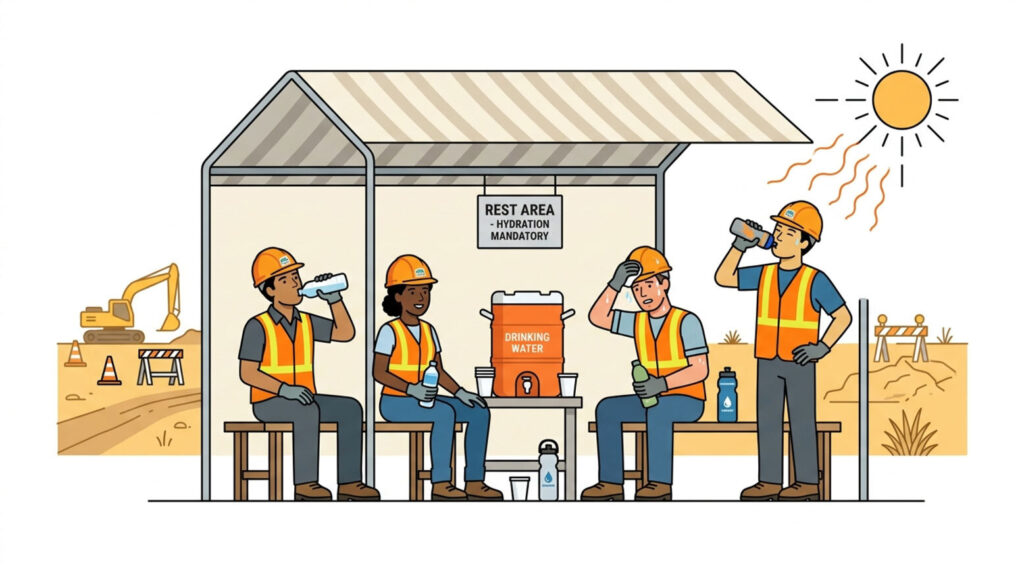
- Provide suitable shade – Workers who work outdoors need somewhere protected for rest breaks; depending on the workplace, this might include a fixed shelter, a temporary canopy, a vehicle cabin, or a nearby indoor welfare area. If there is any workstation that is directly in the sunlight, it should be moved to a location where the task and site allow. Also, employers should remember that some UV radiation passes through gaps in shade or reflects from nearby surfaces.
- Support protective clothing – Closely woven clothing that covers the shoulders, arms, and legs provides an important physical barrier. The workwear should remain suitable for the job, the temperature, and the required level of protection. Wide-brimmed hats or hats with neck protection help cover the face, ears and neck, provided they remain compatible with required head protection. UV-protective eyewear also supports eye health.
- Use sunscreen correctly – Sunscreen protects areas which are left uncovered by clothing; the NHS recommends a product with at least SPF 30 for UVB protection and a minimum four-star UVA rating. Your employees must apply a generous amount of sunscreen to exposed areas, including the face, ears, neck, hands and any area of thinning hair. Reapplication is essential, particularly after sweating or when the product rubs off; manufacturer instructions should always be followed. The sunscreen should support other controls, not replace shade and protective clothing.
Building sun safety into workplace culture
A written policy has limited value if employees feel unable to follow its guidance during a busy workday. As managers and supervisors, you should make sun protection part of normal workplace behaviour; workers need reasonable access to shade, protective clothing and enough time to apply sunscreen properly. Supervisors should follow the same guidance and address attitudes which present tanning or sunburn as harmless. The short seasonal reminders often work better than a single annual message, and employers might include sun safety in:
- Spring and summer toolbox talks
- Site inductions
- Digital safety updates
- Posters in welfare areas
- Daily briefings during periods of high UV
Feedback from employees must be collected from time to time; workers often identify practical issues, such as unsuitable uniforms, limited shade, or sunscreen that interferes with gloves and other equipment. Reviewing these concerns helps employers select workable controls.
Helping employees recognise changes in their skin
In the organisation, employees should be encouraged to check their skin regularly and report health concerns through the appropriate workplace process. Managers should respond supportively, but they should not attempt to diagnose a skin condition. The warning signs requiring medical advice include the following:
- New mole, mark, growth or lump
- Mole changing in size, shape or colour
- Sore which does not heal
- Persistent scaly or crusted patch
- Area which repeatedly bleeds, itches or becomes painful
- Change in the texture or appearance of an existing mark
If your employees notice a new, changing or persistent concern, then they should immediately contact their GP. Early medical assessment is important because skin cancer is often easier to treat when identified early.
How occupational health supports skin health at work
Occupational health provides employers with a structured approach to managing employee health concerns alongside workplace risks. Some support might include reviewing the health demands of outdoor roles, advising on suitable workplace adjustments and providing confidential guidance to employees. The occupational health professionals also help managers respond consistently when an employee reports a skin problem, medication-related sensitivity or medical condition affecting outdoor work.
The following support should form part of a wider approach to workplace skin health as employees might face several risks at once, including sun exposure, chemicals, wet work, oils, dust and repeated contact with protective gloves. Where hazardous substances present a recognised risk of occupational dermatitis or other work-related conditions, appropriate health surveillance might also be required. Sun exposure alone does not automatically create a statutory requirement for formal skin health surveillance. The correct approach depends on the hazards present, the risk assessment and the relevant legal duties.
A year-round approach to workplace skin health
A workplace sun safety program should not begin only after you witness the first case of sunburn. As employers, it is your duty to review outdoor work arrangements before spring, brief employees, and confirm that suitable controls are in place. Risk assessments also need to be reviewed when roles, work locations, uniforms, or shift patterns change. Reports of sunburn, employee concerns, and feedback about existing controls should prompt further review. Protective skin health in the workplace depends on consistent and practical action. By planning work around high-UV periods, providing shade, supporting appropriate clothing, and encouraging early reporting, avoidable harm can be reduced.
How Healthscreen UK supports employers
At Healthscreen UK, we support employers across England and Wales with reliable, compliant occupational health services. Our support includes health surveillance, safety-critical medicals, management referrals, drug and alcohol screening, biological monitoring, workplace vaccinations, pre-employment assessments and employee well-being services. Our services are delivered at your workplace, through fully equipped mobile medical units and from occupational health clinics. We are SEQOHS-accredited and RISQS-approved, giving employers confidence in the quality, governance, and reliability of the service.
FAQs
Q. Does cloudy weather reduce UV exposure at work?
Cloudy or cool weather does not remove the risk of UV exposure; UV radiation still reaches the skin when the temperature feels mild. As employers, you should check the UV index rather than relying on temperature or visible sunshine.
Q. As an employer, do I have any legal obligation to provide suncream or sunglasses?
There is no legal obligation, but the Health and Safety Executive (HSE) encourages you to assess the work environment and include sun-protective gear and essentials for outdoor workers in your routine health and safety training and advises workers to keep covered during the summer months.
Q. Usually at what UV level should the outdoor workers use sun protection?
When the UV index reaches 3 or above, sun protection is recommended. You should check the daily UV forecast and implement appropriate measures, including providing shade, wearing protective clothing, and adjusting outdoor work schedules where practical.
Q. Is skin health surveillance required for outdoor workers?
Sun exposure alone does not automatically require formal skin health surveillance. The need depends on the workplace hazards, risk assessment and relevant legal duties. Occupational health advice helps employers decide which health measures are appropriate.
Q. How does occupational health support skin health in the workplace?
The occupational health service supports employers by reviewing workplace health risks, advising on suitable adjustments and providing confidential guidance to employees. The support also covers broader skin risks associated with chemicals, wet work, dust, oils, and occupational dermatitis.
Q. When should an employee seek medical advice about a skin change?
Employees should contact their GP if they notice a new or changing mole, a sore that does not heal, a persistent scaly patch, or an area that repeatedly bleeds, itches, or becomes painful. As managers you should support early reporting without attempting to diagnose the condition.